
 Kevin Perez
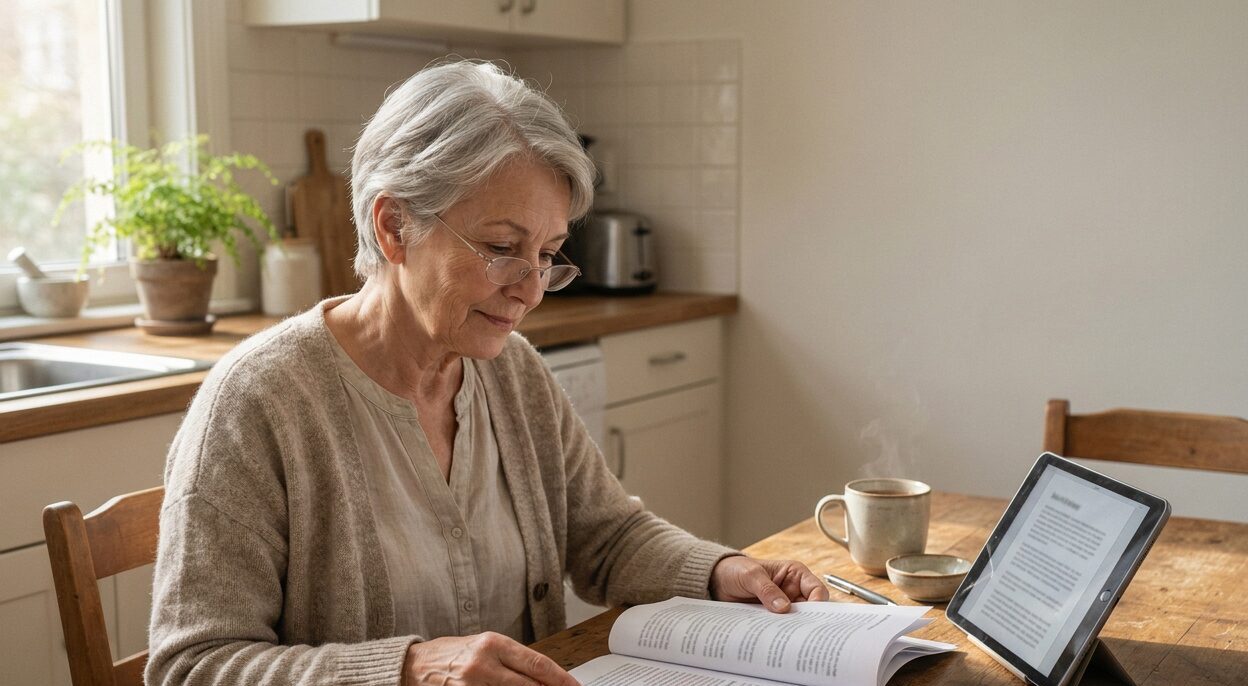
Ruth has read all her life. At seventy, a twelve-page insurance contract lands on her desk, and she catches herself rereading the same sentence three times. Her curiosity and her love of text are intact, yet the pace is not quite what it was. What is going on when reading gets a little slower, and what should we do about it?
What changes with age in the way we read?
The path of the eyes, first of all. Eye tracking records eye movements during reading: where the gaze lands, for how long, and when it goes back. In broad strokes, an experienced reader does not read word by word. The gaze moves in small jumps, skips some short or expected words and lingers on the ones that resist. Older readers leave a slightly different signature in those recordings than young adults do.
Reading feels effortless from the inside, so the recordings are a useful window on what the eyes actually do. That says little about intelligence or enjoyment of reading. It only describes how a text gets scanned, which is useful when deciding how to adapt it.
Why do the eyes go back more often?
Researchers suggest that word processing gets slower, which pushes readers toward a riskier strategy: skipping more words, then going back to check. These regressions, as eye-movement researchers call them, look like skimming followed by rereading whatever slipped past. To the reader it can feel like stumbling, when they are in fact checking their understanding.
The explanation comes from computer simulations of reading, not from a direct measure of processing speed. It remains an interpretation, a plausible one that fits the observations described below.
What does the research show?
Keith Rayner and colleagues had young adults and older readers read sentences containing target words that varied in frequency or in predictability from context. Half the sentences were printed in an easy font, half in a harder one. The study, published in 2006 in Psychology and Aging, tracked readers’ eye movements.
Effects of frequency, predictability and font showed up in both groups. Older readers reacted more strongly, skipped target words more often and made more regressions, including back to those very words. In other words, the features that make a word harder for anyone made it somewhat harder for older readers still.
A few limits apply. We cite no figures, because the study’s abstract gives none. It deals with isolated sentences rather than whole documents, and the slowing-down explanation rests on a model.
Does this apply to every older reader?
No, and the caution matters. The study compares groups: it describes average tendencies, not individuals. A seventy-year-old can read faster and more securely than a tired thirty-year-old, or one working in a foreign language. Eyesight, lighting, tiredness, language and subject matter all play a part as well, at any age. That reasoning is our own.
One detail of the study invites a wider view: font difficulty affected both groups, so how a text is presented matters to everybody. As for going back, it simply means checking what you have read, which is a rather good habit.
What helps with a dense text?
Work on the text rather than on the reader. A few simple levers, all drawn from our own reasoning: pick a clean, reasonably large font, since font difficulty weighs on every reader; read in short sections with a pause between them; start with an overview so that less predictable words arrive in a frame you already know; have a passage read aloud when your eyes tire. You can also alternate, reading one passage yourself and listening to the next. Each of these takes little effort and can be set to taste. A twelve-page document is a lot to absorb in one go, and splitting it over several sittings costs nothing.
Ruth, the reader from the start, can enlarge the contract, skim it first through a summary, then reread closely only the clauses that concern her.
How can a tool help without talking down to people?
By letting the person choose the pace and the steps. An imposed simplified version decides for the reader, whereas an aid you can switch on or off leaves them in charge. Nobody should feel that a screen has decided what they are able to read, and that is why the choices stay with the person.
Resoomer, a free cognitive studio that helps you read, summarize and rephrase texts, offers read-aloud, summary, rephrasing and translation, with no account to create. Everyone chains these steps as they see fit. The aim is to make reading accessible to everyone, and the original text stays within reach for checking. What matters is being able to stop at any step: reading only the summary, listening to a passage, or going back to the full text.
A well-presented text, read at a pace you choose, serves readers of every age.